Do You Need To Book Monet's Garden In Advance?
Booking Monet's garden is not required but is recommended on weekends and holidays, and e-tickets are non-refundable. Here is what the official rules mean for your visit.

Monet's house and gardens in Giverny sold tickets at a gate for decades, and they still do. But the foundation that runs the site now runs an online quota, warns of long waits once that quota is exhausted, and holds e-tickets to rules that catch careless buyers out. The short version: you do not have to book ahead, you simply should on certain days, and you should understand what you are buying before you click. This page sets out the official booking rules for the 2026 season, what they mean in practice, and how the Paris tours that bundle an entry ticket fit into the picture.
Is A Reservation Obligatory For Monet's Garden?
No. The foundation that operates Monet's house and gardens states plainly that booking is not mandatory, only recommended for weekends and public holidays. Tickets are also sold on site every day from 9:30, an hour before the gardens open at 10:00. A booked e-ticket secures your admission for the day, and the house recommends booking ahead at busy times such as weekends and public holidays.
That distinction matters more than it first appears. Many major European attractions have moved to strict timed slots, and travelers often assume Giverny works the same way. It does not. The official useful information page frames reservation as a comfort measure rather than a requirement: the site recommends it for weekends and French public holidays, when day-trip pressure from Paris peaks, and stays quiet about weekdays outside high summer.
The nuance is capacity. Once the online quota for a given day is reached, the foundation warns that heavy crowds and a significant wait should be expected on site. On-site sales continue regardless, subject to the site's overall capacity, but a late arrival on a busy Saturday can mean standing in line during the hours you came to spend among the flower beds. The booking question is therefore really a crowd question, and the crowd pattern through the season is covered in detail in the guide to crowds and queues at Giverny.
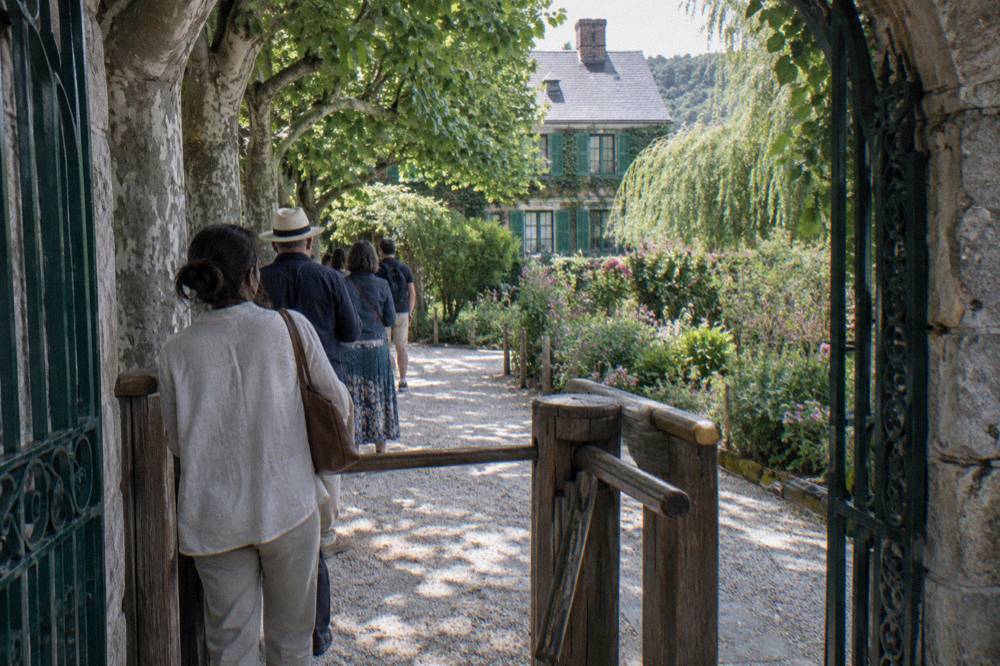
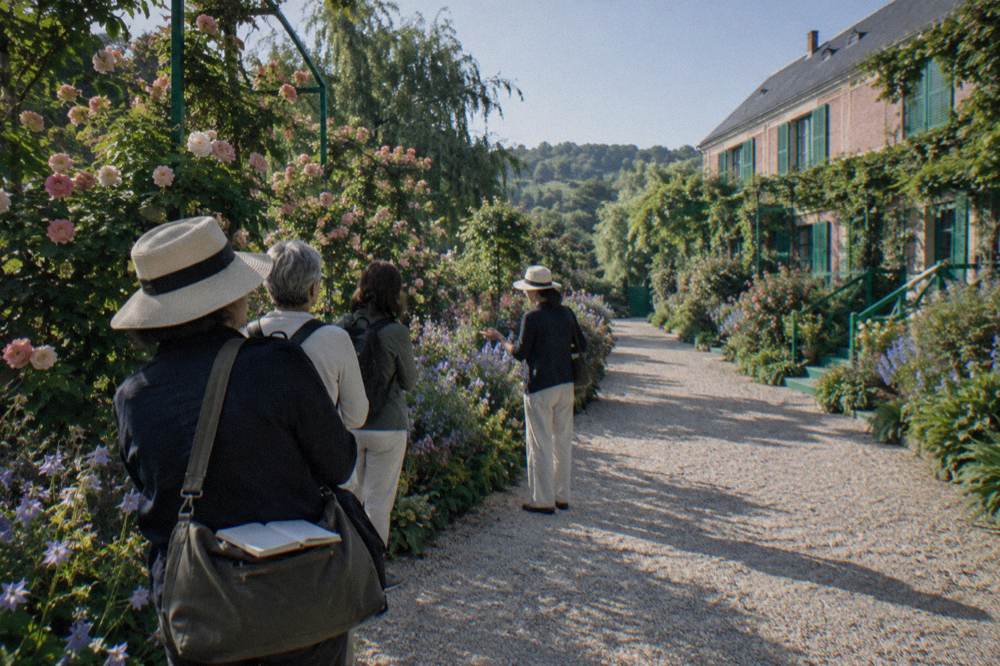
For most of the season, on a weekday morning, buying on site is a perfectly reasonable plan. Adults pay 13 euros, children aged 7 to 17 pay 7 euros, under-7s enter free, and students pay 7 euros. Booking ahead costs the same, it just removes the uncertainty. The ticket itself buys the same visit either way: a free, unguided walk through the house, the studio, the Clos Normand flower garden in front of the house, and the water garden with the Japanese bridge behind it. Nobody checks how you bought your ticket at the turnstile, only that you have one.
It is also worth knowing that the foundation's own pages point out that resellers sell tickets too, and that the site's stated recommended visit is 1h30 to 2h. Those two facts together shape the decision. If you are buying a standalone ticket for a short visit on a quiet day, the gate is fine. If you are building a full day around Giverny, or traveling on a peak date, the certainty of a booked ticket or a bundled tour is worth more than the few minutes a gate purchase saves.
If you would rather have the ticket decision made for you, a tour that bundles entry is one route. The half-day trip from Paris with entry included, rated 4.5 from 3,546 reviews and priced from $66 per person, is the most reviewed listing of this kind, and its coach timing means you arrive with the group rather than with a standalone ticket problem.
Which Days Actually Warrant Booking Ahead?
Weekends and French public holidays are the days the foundation itself flags, and mid-May through August adds crowd pressure on top. Weekdays outside school holidays, especially Tuesday to Thursday, are the days when on-site purchase is least likely to cost you time. Early morning at opening, or late afternoon after about 16:00, are the calmest windows on any day.
The seasonal pattern is consistent. Late May and June bring the wisteria, irises and peonies that draw the largest garden crowds of the year, and July and August add the full summer travel season on top. October draws its own wave for the autumn light and the dahlias, and the season closes on 1 November. If your trip falls in one of those peaks and lands on a Saturday, booking stops being advice and becomes planning.

A practical way to think about it, drawing on the season's general rhythm:
| When you visit | Booking recommendation | Why |
|---|---|---|
| Weekend or French public holiday, any month | Book ahead | The foundation explicitly recommends it for these days |
| July or August, any day | Book ahead | Peak season combines garden interest with maximum travel demand |
| Late May or June weekend | Book ahead | Wisteria, iris and peony weeks draw the largest crowds of the season |
| Weekday, April or September | On-site is usually fine | Quieter shoulder weeks, shorter lines |
| Weekday, October | Consider booking | Autumn color draws steady visitors, though weekdays stay calmer |
One more planning lever: the water lilies Monet painted for decades typically peak from late June through August, which is exactly when the crowds peak too. Visitors chasing both the blooms and a calm garden often land on a September weekday instead, when the lilies can still be going and the queue pressure has eased. The month-by-month detail is in when to visit Monet's garden.
French public holidays deserve a special note for overseas visitors, because they do not always line up with the obvious ones. Early May brings a cluster of them, and the long spring weekends that Parisians treat as getaway days are exactly the days Giverny feels them. If you are planning around a specific date and cannot move it, a quick check of the French holiday calendar before you book your Paris accommodation will tell you whether your Giverny day falls on one of the foundation's recommended-booking days or not.
If reading this you realize your date is a busy one and you would rather outsource the whole morning, a small-group option like the minivan trip rated 4.8 from 2,005 reviews, from $148 per person, handles transport and entry together.
What Are The E-Ticket Rules Once You Book?
E-tickets for Monet's house and gardens are not refundable. They can be modified under conditions until 30 April 2026, and from 1 May 2026 they are final and cannot be changed. Booking ahead therefore means committing to a date, so it is worth being certain of your Paris itinerary before you buy.
This is the part of the booking question that costs people money. The non-refundable rule is stated on the official site, and it applies to the direct e-tickets, not necessarily to every reseller's terms, so if you buy through a third party, read that seller's cancellation policy rather than assuming it matches. The modification window gives some flexibility in the early season, but by the main travel months of May onward, an e-ticket is a fixed date.
Practical consequences follow. If your Paris plans might shift, a weekday on-site purchase gives you total flexibility, since you simply buy when you arrive. If your plans are locked, an e-ticket costs nothing extra and buys certainty. What you should not do is buy an e-ticket for a speculative date in July and assume you can move it when your plans change.
Free and reduced categories add one more wrinkle. Discounted tickets for children, students and disabled visitors exist, at the prices above, but the free admission categories are granted on site with proof, not online. If someone in your party qualifies for free entry, they cannot book that ticket in advance; they present their proof at the gate while the rest of the party uses e-tickets. Groups of 20 or more pay a reduced adult rate of 12 euros but must go through the groups desk.
A family example shows how the pieces combine. Two adults with e-tickets, a 9-year-old and a 5-year-old, arrive together on a June Saturday. The adults booked ahead because the foundation recommends it for weekends, the 9-year-old's 7 euro ticket can be bought on site or in advance, and the 5-year-old simply walks in, since under-7s are free and that category is granted at the gate. The family's total ticket cost is 33 euros, and the only part that had to be decided in advance was whether the adults wanted to skip the weekend line.
Can You Just Buy At The Gate On The Day?
Yes, tickets are sold on site daily from 9:30 to 17:30 throughout the season, which runs 1 April to 1 November. The garden opens at 10:00 and closes at 18:00, with last admission at 17:30. The catch is that once the day's online quota has been reached, the foundation warns of heavy crowds and a long wait on site.
So the gate is always open in principle, and for much of the season it works smoothly. The risk concentrates on exactly the days the foundation names: weekends, holidays, and the peak bloom weeks. On those days the on-site line absorbs everyone who did not book, plus the walk-up coach and independent traffic, and the wait is the price of skipping the reservation.
Two habits make a gate purchase much safer. First, arrive for the 9:30 ticket window or shortly after, so you are near the front of whatever line forms rather than at the back. Second, avoid the middle of the day, when tour groups from Paris arrive in waves; a late-afternoon arrival after about 16:00 often finds both a short line and softer light in the garden.
The recommended visit length on site is 1h30 to 2h, unguided. Building your day around that figure, rather than around an assumption of instant entry, keeps the plan realistic whether you book or not. For everything the visit itself contains, the house, the Clos Normand flower garden, the water garden and the Japanese bridge, see the guide to what to see in Giverny.
Independent travelers arriving by train follow the same logic with one extra step. The direct TER from Paris Saint-Lazare to Vernon-Giverny takes about 45 minutes to an hour, roughly 20 to 27 trains a day serve the route, and the SN'go! shuttle from the station to the village costs 5 euros one way or 10 euros return through the season, seats subject to availability. Because the shuttle is timed to trains, an early departure naturally lands you near the front of the gate line, while a mid-morning train lands you in the middle of the day's arrivals. The train guide from Paris to Giverny covers the timetable considerations, including the official advice to check schedules because of works on the line.
If your tolerance for any line, long or short, is zero, the tours that include an entrance ticket in the price are the clean workaround, and among local options the guided tour of Monet's house and gardens from $66 per person, rated 4.8 from 794 reviews, includes tickets and a licensed local guide in a visit of about 2 hours.
Do Tours Bypass The Booking Question Entirely?
Partly. Tours that list an entrance ticket to Monet's house and gardens among their inclusions remove you from the individual ticket system, since the operator secures admission for the group. What they do not do is beat the site's capacity rules, and group entry still follows the site's admission process, so timing depends on the tour schedule, not on your ticket.
This is why tour listings matter to a booking question. On this site's listings, an entry ticket is included on the coach day trips from $66 per person, on the small-group minivan trips in the $148 to $154 range, and on the local guided visits that meet in Giverny itself. The tour description states the inclusion, and that is the claim to rely on when comparing, because not every transport product includes entry.
The distinctions are worth checking line by line. The small-group minivan trip rated 4.8 from 2,005 reviews lists entrance fees among its inclusions and runs about 4 hours 30 minutes from Paris. The half-day coach trip rated 4.5 from 3,546 reviews includes entry fees and a self-guided audio app in 10 languages. Both remove the ticket decision from your plate; neither can promise an empty garden, because no operator controls how many other visitors book the same day.
A comparison of what the main formats handle for you:
| Format | Example listing | Entry ticket | Guide | Price basis |
|---|---|---|---|---|
| Coach half-day from Paris | From $66, rated 4.2 from 3,032 reviews | Included | Audio or live guide, by option | per person |
| Coach half-day, longer window | From $66, rated 4.5 from 3,546 reviews | Included | Guide plus audio app | per person |
| Small-group minivan | From $148, rated 4.8 from 2,005 reviews | Included | Expert guide and chauffeur | per person |
| Local guided visit in Giverny | From $66, rated 4.8 from 794 reviews | Included | Licensed local guide | per person |
The local guided visit deserves a special mention for the booking question, because it is the related tour this site features for exactly this scenario: it meets at Restaurant Les Nymphéas on rue Claude Monet, includes the entrance ticket, and puts a licensed guide beside you for roughly the length of the recommended visit. You arrive in Giverny by train or car, and the ticket problem is already solved.
Cancellation terms add a second layer of value on the tour side. The tours on this site list free cancellation, which stands in deliberate contrast to the non-refundable e-ticket rule for direct admission. A traveler whose Paris itinerary is still loose can therefore hold a tour booking with more flexibility than a direct e-ticket from May onward, and that asymmetry, more than the coach seat itself, is what the bundled product is really selling on peak dates.
What About Combined Tickets And The Impressionism Museum?
Combined tickets exist, but only for individuals and only on site, never online. A ticket combining Monet's house with the Musee des Impressionnismes Giverny costs 25 euros for an adult, with the museum alone at 12 euros adult and free entry under 18. If you want a combined ticket, the booking-ahead question answers itself: you buy it at the gate.
The museum sits a few minutes' walk from Monet's garden in the same village and mounts a temporary exhibition each season; the 2026 exhibition runs 17 July to 1 November. Because the combined ticket is an on-site-only product, visitors who booked a Monet e-ticket online and then decide they want the museum too simply pay the museum's own admission at its door, on the museum's visit page terms.
Paris combinations work differently and are worth keeping straight. Combined on-site tickets also exist for the Musee Marmottan Monet at 27 euros adult and the Musee de l'Orangerie at 25.50 euros adult, both sold on site at Giverny, both individual only. These pair a garden visit with the Paris museums that hold major Monet collections, and the comparison of the water lilies at the Orangerie and Giverny covers which order makes sense.
For visitors combining Giverny with Versailles on one long day, the booking logic shifts to the Versailles side, where the 2026 Passport is 35 euros in high season and the palace closes on Mondays. That planning is laid out in the Giverny and Versailles tour guide.
What If The Online Quota Is Already Full?
If the online quota for your date is exhausted, your options are on-site purchase from 9:30 with an expected wait, a tour listing that still has places and includes entry, or a different date. The foundation's own warning is that once the quota is reached, heavy crowds and a significant wait should be expected on site, so plan the rest of your day around that wait.
The full-quota scenario is rare outside the peak weekends, but it does happen, and it is the one situation where the booking question has a hard edge. Arriving early for the 9:30 window is the first move. The second is flexibility on date: a Sunday that shows full online will often have a calm Tuesday beside it, and the garden changes character through the week in ways the day-of-the-week guide details.
The third option is the tour route. Tour operators secure group admission separately from the individual quota, so a listing with entry included can be available even when individual online sales for that date are exhausted. This is not a guarantee for every tour on every date, so check the operator's live listing for availability before assuming it, but it is a genuine escape hatch on peak days, and one reason the bundled tours hold their value even beside a cheap train ticket.
Whatever route you choose, the decision is less about the ticket than about your time. A 13 euro ticket bought at 9:30 on a Tuesday costs you nothing in waiting. The same ticket bought once the online quota has filled on a July Saturday costs you an hour of garden time. Booking ahead, or letting a tour carry the entry, is simply how you buy that hour back; the tour comparison lays out those options side by side.
Common Questions About Booking Monet's Garden
Are e-tickets for Monet's garden refundable?
No. E-tickets are not refundable. They can be modified under conditions until 30 April 2026 and are final and non-changeable from 1 May 2026, so book a date you are certain about.
Does Monet's garden have timed entry slots?
The official site doesn't say; it sells a skip-the-line e-ticket online. An e-ticket secures admission for the day, not for a specific arrival time. The site opens at 10:00 and closes at 18:00, with last admission at 17:30.
Can children enter Monet's garden for free?
Children under 7 enter free. Ages 7 to 17 pay 7 euros, the same as students, and adults pay 13 euros. Other free categories are granted on site with proof.
Do tours to Giverny include the entrance ticket?
Many do. Coach half-day trips from $66 per person, small-group minivan trips from $148 per person, and the local guided visit from $66 per person all list an entrance ticket among their inclusions. Check each listing, because inclusion terms differ between products.
Can you buy a combined ticket online?
No. Combined tickets with the Musee des Impressionnismes, the Musee Marmottan Monet and the Musee de l'Orangerie are sold on site only, for individuals.