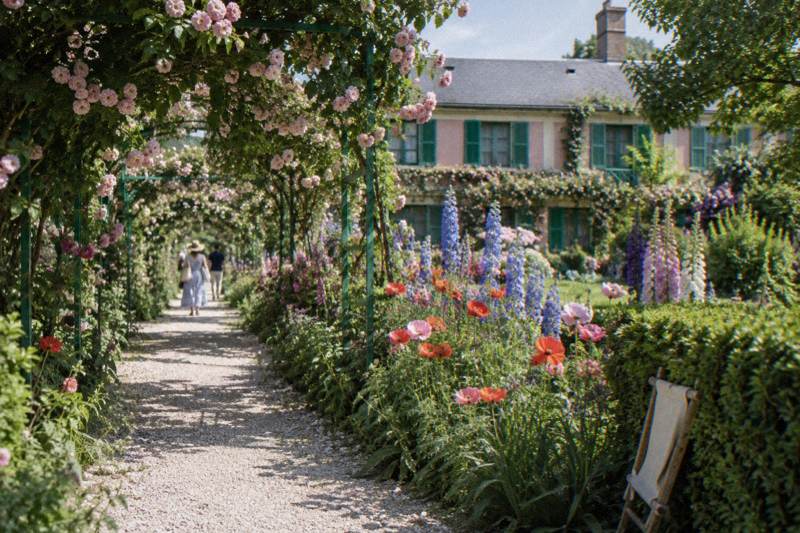
Why Is Monet's Garden Famous?
Monet's garden at Giverny is famous because the painter designed it as a living subject and painted it for over forty years. Here is what makes the house, the Clos Normand and the water lily pond unlike any other garden.
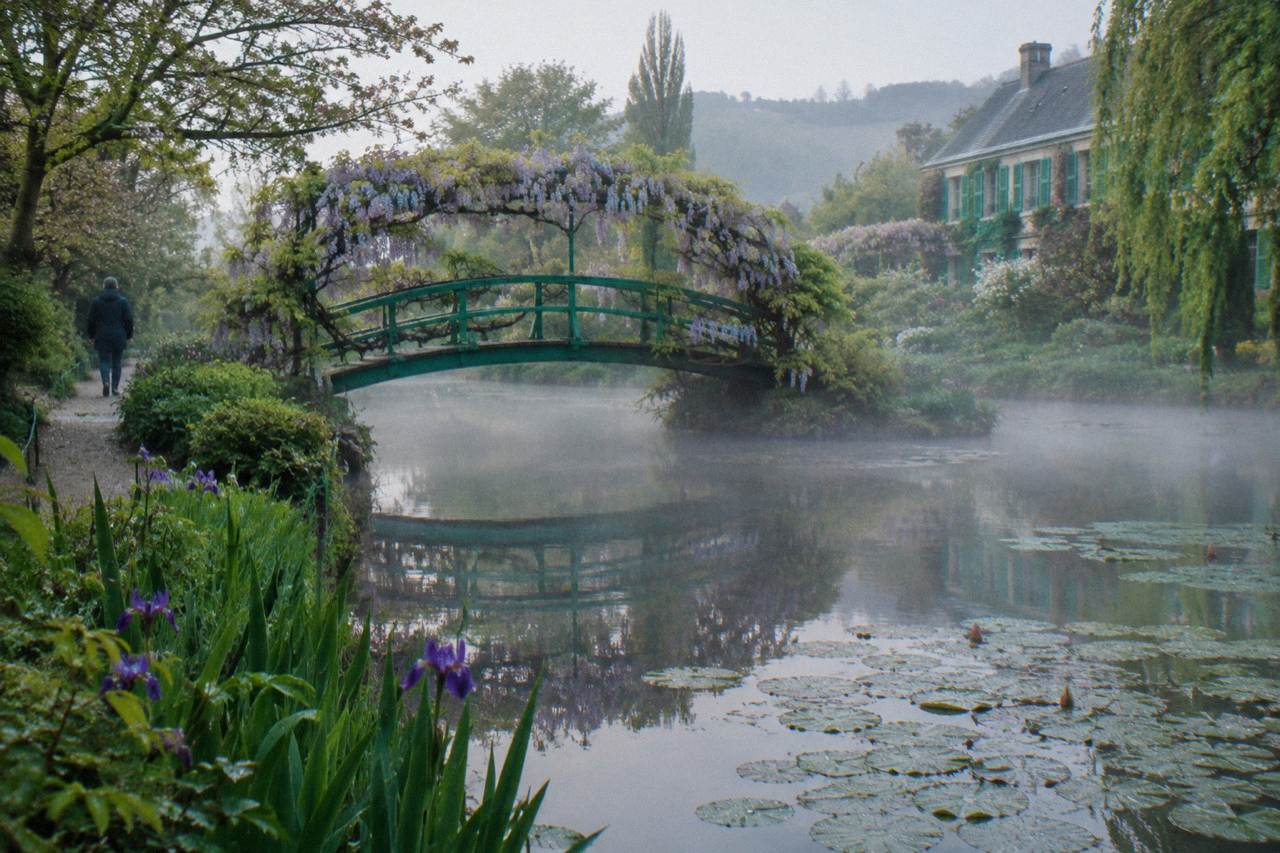
Claude Monet moved to Giverny in 1883, rented a farmhouse with a barn of a garden behind it, and over the next 43 years turned that plot into the most painted garden in the world. He did not garden the way a botanist gardens. He gardened the way a colorist paints, in masses and contrasts and long drifting lines, and then he painted what he had planted, over and over, until the garden and the paintings became impossible to separate. That double life, a real working garden that is also a body of work, is the short answer to why the place is famous. For the full story of how he built the garden, and what to look for when you walk through it yourself, see our history of Monet's garden at Giverny.
The longer answer runs through tulips and nasturtiums, a Japanese bridge smothered in wisteria, a water lily pond that Monet built after 1893 against local opposition, and a village about 75 km from Paris that now receives visitors by the coach load every day of a seven-month season. This page walks through each strand of the fame: the paintings, the design, the pond, the restoration, and the way you can still stand in the exact spots where the canvases were made.
The fame is also self-sustaining in a way few heritage sites manage. Every spring the gardeners replant the beds, every summer the pond refills with lilies, and every year a new wave of visitors arrives from Paris having first met the garden on a museum wall or in a book. The paintings send people to the garden, and the garden sends people back to the paintings. Very few places close that loop so completely.
What Did Monet Actually Paint At Giverny?
Monet painted the garden itself: the Clos Normand flower garden in front of the house, the water lily pond and Japanese bridge across the road, the wisteria, the irises, the nasturtiums and the willows, again and again across four decades. Giverny is where the water lily series was made, the Water Lilies panels that closed his career and were painted for Paris.
He arrived as a painter of riverside towns and made his name on landscapes, but Giverny gave him something no painter had engineered for himself before: total control of the subject. When he could not find the motifs he wanted, he grew them. The flower garden, the Clos Normand, is a rectangular Norman orchard plot he converted into long borders of color, arranged so that from the house's second-floor vantage the beds read as overlapping ribbons. The pond, dug after 1893 once he acquired the meadow across the local road and diverted a branch of the Ru stream, was built specifically to hold floating flowers and reflections.
The water lilies came to dominate. The Nymphéas series, hundreds of canvases of the pond surface with no shore and sometimes no horizon, was painted at Giverny over the last decades of his life and became the basis for the panoramic Water Lilies rooms installed at the Musee de l'Orangerie in Paris, where visitors still sit surrounded by the pond on all sides. A combined ticket sold on site at Giverny, 25.50 euros adult with the Orangerie, exists precisely because the two experiences are two halves of one project.
It is worth pausing on how unusual that arrangement was. Painters before Monet had kept gardens, and gardeners had made beautiful gardens, but nobody before him had treated a garden as a studio prop to be composed, edited and replanted for pictorial reasons. He pulled out flowers whose color disagreed with a planned canvas, delayed plantings to suit a series, and reportedly instructed his gardeners to keep the pond's surface cleaned of debris so the water would mirror the sky properly. The garden was subordinate to the art, and that is exactly why the art got so good.
The garden is open daily from 1 April to 1 November, 10:00 to 18:00, with last admission at 17:30, per the official site's practical information. The reopening date for the following season has not yet been published, so check the official page before planning a spring visit.
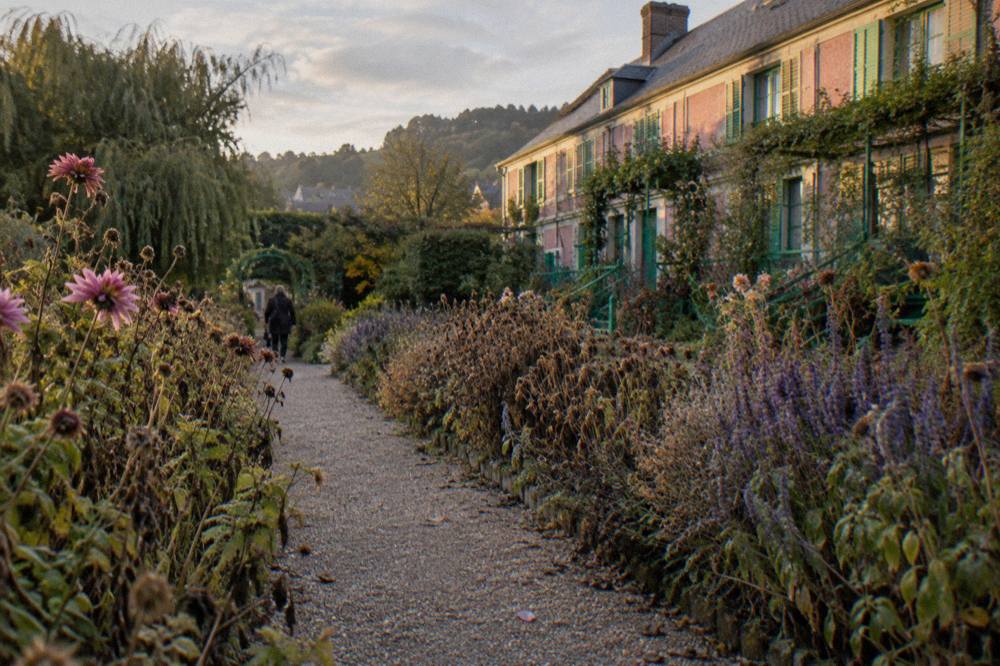
Because the paintings are the reason most visitors come, the tours that explain them tend to be the ones people remember. If you want the story told on site rather than reading it off your phone, these are the three formats worth comparing first.
How Did A Working Garden Become A Work Of Art?
Monet treated the garden as a living canvas: he chose flowers for color mass and bloom sequence rather than horticultural fashion, kept gardeners to replant faded beds mid-season, and composed the views the way he composed a painting, so walking the garden retraces his working method. Visitors are not just seeing where he lived, they are seeing a design he made to be painted.
The Clos Normand is the clearest proof. Traditional Norman cottage gardens mix everything in small patches; Monet instead planted enormous single-color drifts, iron arches of climbing roses down the central alley, and spring bulbs by the thousand so that April's tulips and daffodils gave way to May's irises and peonies, then June roses, then the July and August dahlias and nasturtiums. The garden was, and still is, run to have something at full color from the first week of the season to the last. In September the nasturtiums carpet the Grande Allée, the main gravel walk, in a river of orange and green that is one of the most photographed single sights in Normandy.
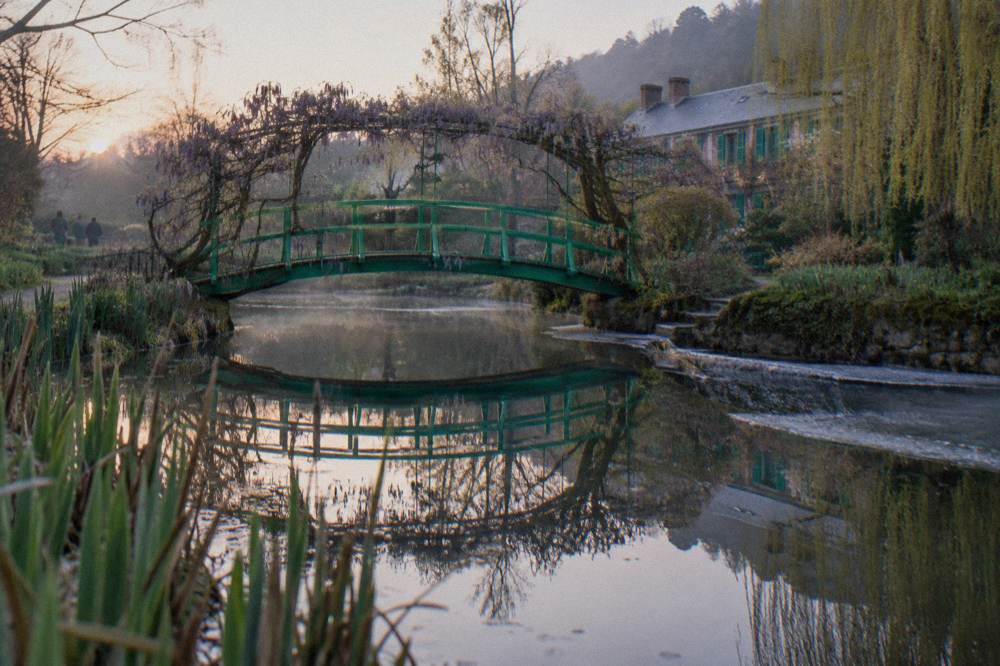
He was also a collector, filling the garden with varieties sourced from Japan and elsewhere: the wisteria on the Japanese bridge, the bamboo and ginkgos by the pond, the water lilies themselves, which he imported and hybridized with the help of horticulturists of the day. The pond's composition, a green arched bridge, willows, reflections and floating pads, draws on Japanese prints he collected decades before the pond existed. Giverny is where Japanese aesthetics and French gardening literally met in the ground.
The scale of the operation surprises people. At his most established Monet employed several gardeners, and the upkeep of the pond alone, the water, the plants and the banks, was a permanent job. Today's team works the same way: the beds are not frozen exhibits but rolling plantings, swapped out as each wave of flowers fades, which is why the garden in late April looks nothing like the garden in late September even though the alleys, arches and pond never move.
That designed quality is what a licensed guide can unlock. The Giverny: Monet's House and Gardens Guided Tour, rated 4.8 from 794 reviews and from $66 per person, spends two hours on site with a licensed local guide who explains exactly this: which beds were planted for which paintings, and why the alleys are where they are. It meets at Restaurant Les Nympheas at 109 Rue Claude Monet, directly in front of the house. For the deeper backstory of the pond itself, read the story behind the water lily pond.
Why Do The Water Lilies Draw The Crowds?
The water lily pond is famous because the paintings made there ended Monet's career at the summit of French art and reshaped how artists treated surface, reflection and time. Standing on the bank, visitors recognize the bridge, the willows and the pads instantly, which is a rare thing: a world-famous artwork you can physically walk into.
The series' fame rests on what Monet did with the motif. By stripping the shore and the sky from his pond views, he removed the anchors of traditional landscape painting and left only water, flowers and mirrored light, changing with every hour of the day. He painted the same pond for decades, in morning fog and afternoon glare, and the late canvases, made as his cataracts blurred his sight, are considered a bridge toward abstraction. The garden is therefore not merely where a painter lived; it is the site of one of art history's long sustained experiments.
The pond itself is smaller than the paintings suggest, and that discrepancy is part of the experience. The Japanese bridge is a compact green arc, and the water garden reads as an intimate enclosed world rather than a grand estate. Gardeners keep the water lilies blooming from late June through August at their peak, with flowers continuing into September and October in mild conditions, so mid-summer visitors see the closest thing to the canvases.
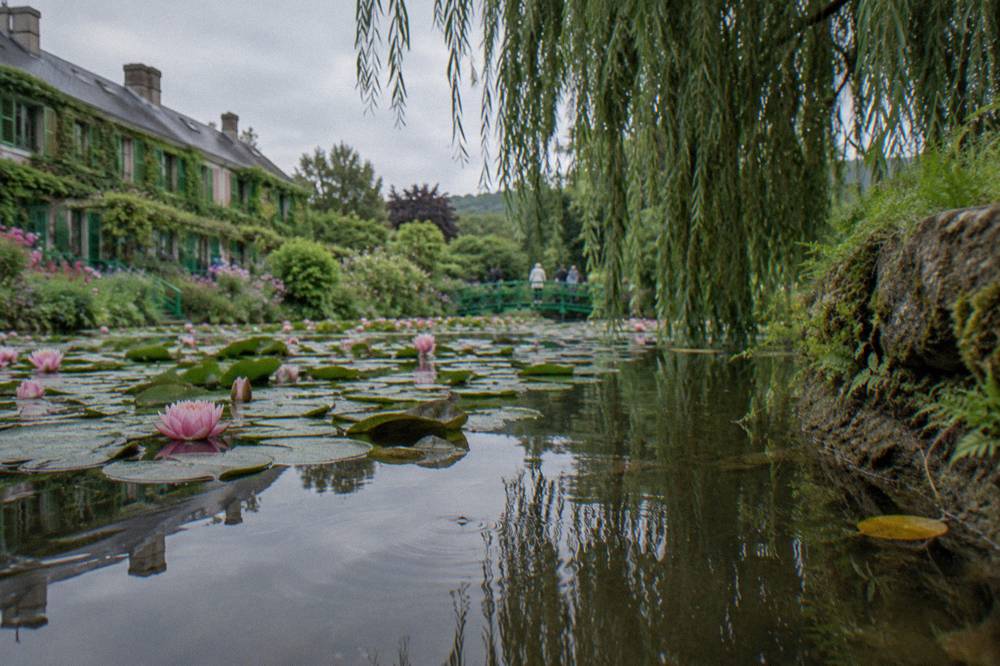
Crowd patterns follow the blooms. May and June, the wisteria, iris and peony weeks, are the busiest; July and August are also very busy; weekdays, especially Tuesday to Thursday, and the 10:00 opening slot or the late afternoon after 16:00, are the calmer choices. For planning around this, see the best time to visit Giverny.
| Month | What the garden is known for | General crowd pattern |
|---|---|---|
| April | Tulips, daffodils, cherry blossom, forget-me-nots | Moderate, building |
| May | Irises, peonies, wisteria on the bridge | Peak crowds |
| June | Climbing roses, early water lilies | Peak crowds |
| July | Water lilies in full bloom, nasturtiums, dahlias | Very busy |
| August | Dahlias, cosmos, water lilies | Very busy |
| September | Nasturtiums carpeting the Grande Allée, asters | Easing |
| October to 1 Nov | Dahlias, chrysanthemums, autumn foliage | Quietest |
Timing matters enough that the format of your visit matters too. A small-group minivan that arrives for the 10:00 opening slot, before the Paris coaches, is one way to see the pond before the day builds; the alternative is a late-afternoon entry. Both approaches are compared in detail in the guide to Giverny crowds and queues.
The Giverny Small-Group Half Day Trip with Monet's Gardens from Paris is built exactly for this: 8 people maximum per minivan, departure from 6 Av. de Wagram, about 4 hours 30 minutes door to door, entry fee included, rated 4.8 from 2,005 reviews and from $148 per person. The listing notes the tour ends next to the Champs Elysées, which suits a museum afternoon.
Why Is The Garden Still Famous A Century Later?
The garden survives almost unchanged, and its authenticity is the draw: the house is pink, the bridge is green, the alleys and pond match the paintings, and the whole site is preserved and replanted every season to Monet's design. Few artist homes anywhere offer this degree of literal recognition between canvas and place, which keeps the fame self-renewing.
After Monet's death the property fell into disrepair and was later restored, replanted from photographs and paintings and accounts of the gardeners, and reopened as a visitor site. That restoration is why the recognition effect works: you stand at the top of the Grande Allée and the view is the view in the canvases, not a modernized approximation. The Fondation's gardeners replant the beds continuously through the season, so the July garden is not the April garden; the site is a working horticultural machine, not a preserved diorama. The wider set of guides lives on the tour comparison homepage.
The paintings' afterlife feeds the visits, and the visits feed the paintings. The Orangerie's Water Lilies rooms, closed Tuesdays and 12.50 euros online, keep the pond in front of every Paris museum-goer, and the combined on-site ticket with Giverny (25.50 euros adult) makes the pilgrimage explicit. The garden also became the model for a whole genre of painter-gardens and artist-designed landscapes that art historians trace directly back to Giverny.
The village around the garden plays its part too. Giverny was a small farming hamlet when Monet found it, and it grew into an artists' colony during his lifetime as painters followed him out from Paris. Today that legacy shows in the Musee des Impressionnismes a short walk from the house, where the 2026 exhibition "Invitation to Daniel Buren, Plantations" runs to 1 November. Visitors with time for an overnight can stay in the village itself at Le Jardin des Plumes, an upscale inn with an on-site restaurant, or at La Dime de Giverny, a guesthouse walkable to Monet's house; budget travelers usually base in Vernon at Hotel Normandy near the station. Once you've settled where to stay, our guide to how many hours you actually need in Giverny helps you shape the rest of your day around the house, the water garden and the village.
Is seeing the garden with a guide worth adding to your trip?
The house itself is part of the fame: the blue kitchen and yellow dining room, the Japanese print collection covering the walls, and the studio wing are all open to visitors. Note the gardens are accessible to reduced-mobility visitors but the house itself is not wheelchair accessible. Photography is welcome, though painting, drawing and picnics are not permitted, and once you exit, exit is final. There is a practical reason for the painting ban that visitors sometimes find ironic: the alleys jam quickly, and dozens of easels would stop the flow entirely. Restaurant Les Nympheas, directly in front of the house, serves meals daily through the same 1 April to 1 November season.
Can You Visit The Exact Spots In The Paintings?
Yes, nearly all of them: the Japanese bridge, the Grande Allée, the water lily pond, the wisteria, the Clos Normand borders and the house's views are all on the visitor route, and the site is compact, with a recommended visit of 1h30 to 2h. Only the unguided, unhurried pace lets you match each viewpoint to its canvas.
The practical basics are simple. Adult entry is 13 euros, children 7 to 17 pay 7 euros, under-7s are free, and booking is recommended on weekends and public holidays rather than mandatory; tickets are also sold on site daily from 9:30, but once the online quota is reached the site warns of heavy crowds and a long wait. The house sells a skip-the-line e-ticket online and recommends booking ahead for weekends and public holidays. E-tickets are non-refundable, and last admission is 17:30. E-tickets bought direct are not refundable.
Students who are not art or art-history students pay 7 euros, disabled visitors pay 6 euros with a companion paying the standard rate, and the free categories are granted on site with proof rather than online. The queue at the gate moves quickly in the first hour after opening, which is one more argument for the earliest arrival you can manage.
For visitors arriving under their own steam, the independent route is a direct TER train from Paris Saint-Lazare to Vernon-Giverny, about 45 minutes to an hour, then the SN'go! shuttle at 5 euros one way or 10 euros return, or a bike ride along the green way. Check timetables before you buy, because works on the line are ongoing. The trade-offs between train and tour are laid out in the train-versus-tour comparison.
Which Tour Format Suits A First Visit?
The three practical formats are a large coach half-day from about $66 per person, a small-group minivan from about $148 per person, and a guided visit you join on site in Giverny from $66 per person. All include entry; they differ in group size, commentary depth and whether Paris transport is included. The most reviewed listing is the half-day coach trip, rated 4.5 from 3,546 reviews.
| Tour | Format | Price | Rating | Duration |
|---|---|---|---|---|
| From Paris: Giverny, Monet's Home & Gardens Half-Day Trip | Coach, shared | from $66 per person | 4.5 from 3,546 reviews | 6 to 11.5 hours |
| Giverny Small-Group Half Day Trip with Monet's Gardens from Paris | Minivan, up to 8 | from $148 per person | 4.8 from 2,005 reviews | 4 hours 30 minutes |
| Giverny: Monet's House and Gardens Guided Tour | On-site guided visit | from $66 per person | 4.8 from 794 reviews | 2 hours |
The coach half-day from Paris, departing from Église Notre-Dame de Compassion near the 17th arrondissement, is the budget and comfort choice: round-trip air-conditioned transport, entry fees, a guide and a self-guided audio app in 10 languages. Its duration range of 6 to 11.5 hours reflects the option that adds the Palace of Versailles in the same day, the classic double-punch for visitors with only one spare day in Paris. The small-group minivan trades the lower price for intimacy and speed, getting 8 people to Giverny and back in about 4 hours 30 minutes. The on-site guided tour suits independent travelers who arrive by train and want a licensed guide's commentary once there; it covers the gardens but leaves you to explore the house at your own pace, and it does not include transport to Giverny.
Whichever format you choose, book ahead for May through August, and go early or late in the day. The garden's fame is well earned, but it is a fame shared with several hundred strangers at noon in July. Visitors who arrive at 10:00 sharp, walk the pond first while the light is still low, and save the Clos Normand and the house for later consistently report the more magical morning. Every listed tour includes free cancellation, so locking in a date early costs nothing but a few minutes.
Common Questions About Monet's Garden
Can you see the water lilies Monet painted?
Yes. The pond and its water lilies are the heart of the visit, blooming from late June through August at their peak and continuing into early autumn in mild conditions. The Japanese bridge, willows and reflections in the paintings are all on the visitor route.
Is Monet's house open to visitors?
Yes, the house, the studio wing and the two gardens are open every day from 1 April to 1 November, 10:00 to 18:00, last admission 17:30. The gardens are accessible to reduced-mobility visitors but the house itself is not wheelchair accessible.
How long should you spend at Monet's garden?
The official recommended visit is 1h30 to 2h, unguided. Allow more if you plan to photograph the pond in different light or also visit the Musee des Impressionnismes a short walk away.
Do you need to book tickets in advance?
Booking is recommended on weekends and public holidays but is not mandatory. Tickets are also sold on site daily from 9:30; once the online quota is reached, the site warns of heavy crowds and a long wait. E-tickets bought direct are not refundable.